
How does blade steel hardness impact the performance of knives & cutting tools?
Blade Steel Hardness Tradeoffs and Characteristics for Knives and Cutting Tools
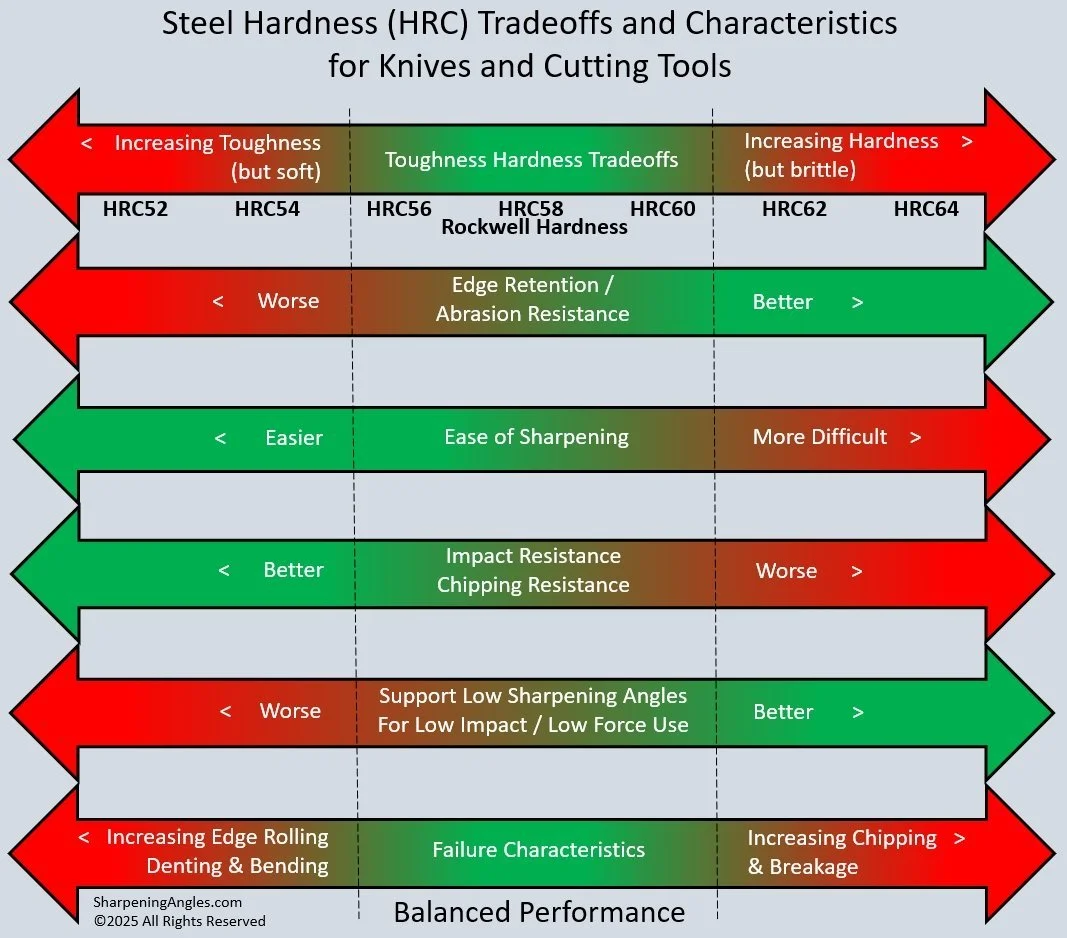
Like sharpening angle, blade hardness involves compromise and tradeoffs. There is no single best blade hardness for all knife and cutting tool types and all applications. Instead optimal blade hardness is driven by the forces that the blade will experience and personal preference of the user regarding the various tradeoffs.
Blade steels range in hardness from about HRC50 to HRC66. As seen in the chart above, this hardness impacts many important performance characteristics. Let’s further explore.
At the lower end of the range the blades are tough - can absorb energy in the form of impacts, lateral forces and torque without chipping or breaking. This is important for striking and chopping blades and tools like machetes, bone cleavers, axes and hatchets for maintenance, durability and safety reasons. At the upper end of the range blades are very hard - can resist abrasion, bending and deforming. This is important for knives and cutting tools which are sharpened to very low (acute) angles and used for careful shaving and and slicing such as straight razors and yanagiba (sushi) knives as the hardness helps to maintain the very fine edge. The middle of the blade hardness range generally provides balanced performance characteristics for most types of knives and cutting tools.
Edge Retention / Edge Holding / Abrasion Resistance is the ability of a blade edge to resist being scratched or worn away. All materials that you are cutting and all materials that your blade comes in contact with are abrasive to some degree. Some materials are only slightly abrasive while others are highly abrasive. As a result when you use your knife or cutting tool microscopic bits of the cutting edge are being scratched or worn away. This occurs at all sharpening angles and is unavoidable. It results in the dulling of the blade through an increase in diameter or thickness of the cutting edge. Harder steels better resist being scratched or worn away through abrasion.
Ease of sharpening is inversely related to abrasion resistance. When sharpening a knife or cutting tool you are using abrasion to your advantage. When moving the blade across the surface of a sharpening stone you are scratching or wearing away bits of the blade to thin the apex resulting in a sharper blade. Since a harder blade has increased abrasion resistance, a harder blade will be harder to scratch or wear away on a sharpening stone.
Impact Resistance / Chipping Resistance improves as a blade steel becomes softer. A softer steel is a tougher steel which better absorbs energy from impacts, lateral forces and torque without chipping or breaking. Softer steels are therefore used with striking blades such as machetes, cleavers and axes as flying chips and breakage would be dangerous. The tradeoff though is that softer tougher blades are more prone to failure through edge denting and rolling. This is countered through higher sharpening angles resulting in a stronger edge. Impact Resistance / Chipping Resistance deteriorates as a blade steel becomes harder. Harder blades are more glass-like and more prone to chipping and breaking. The benefits of a harder blade is abrasion resistance and the ability to support lower sharpening angles without rolling. The hardest blade steels are therefore used with blades that are intended for no impact and sharpened at very low angles such as sushi knives and straight razors.
Support for very low (acute) sharpening angles requires the blade steel to be very hard. With a softer blade steel the fine thin edge would roll and dent and become dull with very little use. Yanagiba (sushi) knives and straight razors are examples of knives made from very hard blade steel to support the very low sharpening angles. They are intended careful slicing and shaving as impacts with a cutting board for example could chip the fine edge. Even worse, dropping either of these could cause the blade to break.
The Failure Characteristics of a blade edge will vary with the hardness of the blade steel. The softest blade steels used for impact tools such as machetes will fail almost exclusively through edge rolling and denting when the forces exceed the strength of the edge. The hardest blade steels used for fine slicing knives and straight razors will fail almost exclusively through edge chipping when the forces exceed the strength of the edge. The mid range of blade steel hardness is best for most types of knives and cutting tools as the compromise provides some forgiveness. When the forces exceed the strength of the edge some failure will initially be in the form of rolling and denting. As the forces continue to increase the edge will eventually chip. Professional butchers tend to use knives at the lower end of the mid-range as dulling through edge rolling is quickly resolved through the proper use of a honing rod. Conversely harder blades do not respond as well to honing and micro-chips require a thorough resharpening for correction.
Sharpening angle impacts Edge Strength regardless of the blade hardness. As the sharpening angle increases the edge strength increases thereby reducing micro-failure through edge rolling, denting and chipping. However, as sharpening angle increases the force to cut (perceived sharpness) gets worse. This is the edge strength / force to cut (sharpness) tradeoff.
Knife Manufacturer Reported Blade Hardnesses, Sharpening Angles & Intended Use
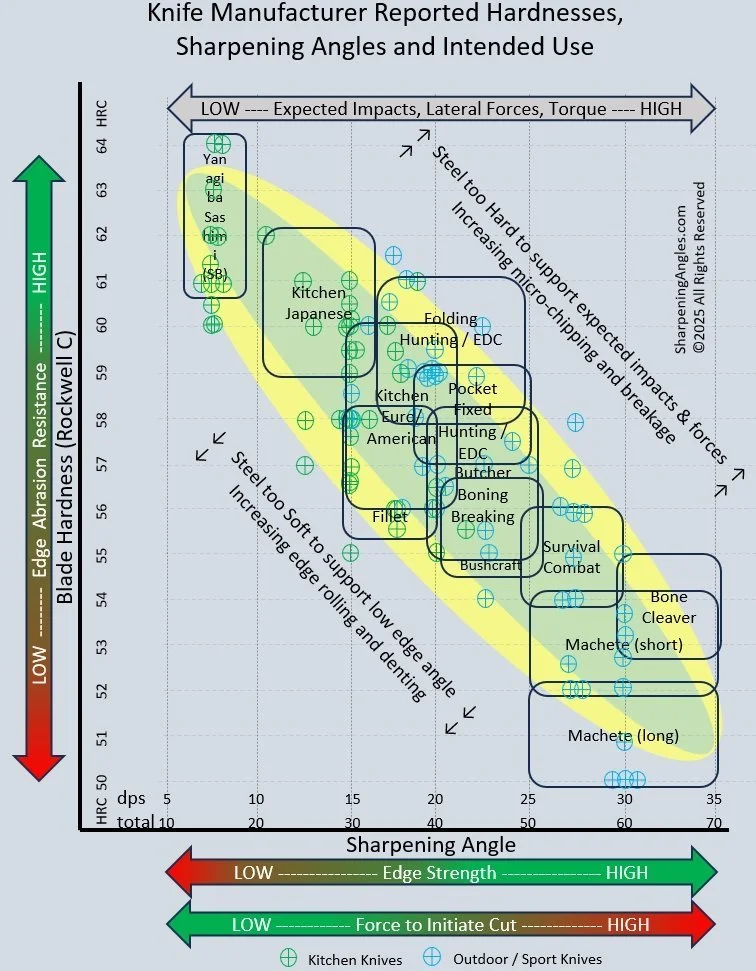
In response to the blade steel hardness tradeoffs and edge strength / force to cut (sharpness) tradeoff, knife and cutting tool manufacturers design their blades to be optimized for the expected forces a particular use type or application will bring. Blades designed for higher expected forces require higher sharpening angles and lower hardness to perform optimally and avoid chipping and breaking. Blades designed for lower expected forces are optimized with lower sharpening angles and a higher hardness to support the thin edge.
In researching the web and printed product literature we have located dozens of manufacturer data points related to their target blade blade hardnesses and target sharpening angles for various types of kitchen knives and outdoor/sport knives. These data points have been summarized in the graph above.
At the top of the graph is a unitless scale of the forces that a knife is expected to experience in the form of impacts, lateral forces and torque. On the vertical axis is a range of HRC (Rockwell C hardness scale) for steel that is typically used for knife blades. The sliding scale on the vertical highlights how abrasion resistance improves as a blade becomes harder. On the horizontal axis are terminal bevel sharpening angles shown as both degrees per side and total degrees. The two sliding scales below the horizontal axis highlight how edge strength or resistance to chipping, rolling and denting improves as the sharpening angle increases and how force to cut (perceived sharpness) deteriorates as the sharpening angle increases.
Within the body of the graph are the manufacturer reported hardnesses and sharpening angles for various knives in their product offering. When a manufacturer offers many knives for the same use type, all with the same sharpening angle but different hardnesses, we only added a single data point for that use type which is consistent with the median hardness value. This prevents overcrowding in the graph while still providing strong data for a particular use type. In addition to the hardness / sharpening angle data points we overlaid intended use types.
So what conclusions can we draw from the data. Knives intended for high force applications such as chopping hard materials are optimized when the steel is relatively soft and the sharpening angle is relatively high. Knives intended for low force applications such as carefully slicing soft materials are optimized when the steel is relatively hard and the sharpening angles are relatively low. The mid-range, lets say HRC 56 to 60 and sharpening angles 15dps to 25dps is where most knives are optimized. In addition, there is certainly a loose linear relationship between hardness and sharpening angle when optimizing a blade for specific use types and expected forces. Manufacturers of quality blades obviously understand this relationship and tend to stay within the optimized zone for the intended use type and expected forces.
So with this understanding how does one decide what angle to sharpen a blade at? The Manufacturer’s Suggested Angle and our Sharpening Angles by Use Type Graph are good starting points. However, there is no substitute for the user’s individual experience with the blade as no two users will use a particular type of blade in exactly the same way. Some are very rough with their blades and others are very careful with them. Our Sharpening Angle Decision Tree and our Sharpening Angles with Coin Stack reference will help you to understand your blade, reflect on your experience and achieve the optimal performance that you are looking for.