
Sharpening Angles by Knife & Cutting Tool Use Type with Impact on Edge Strength
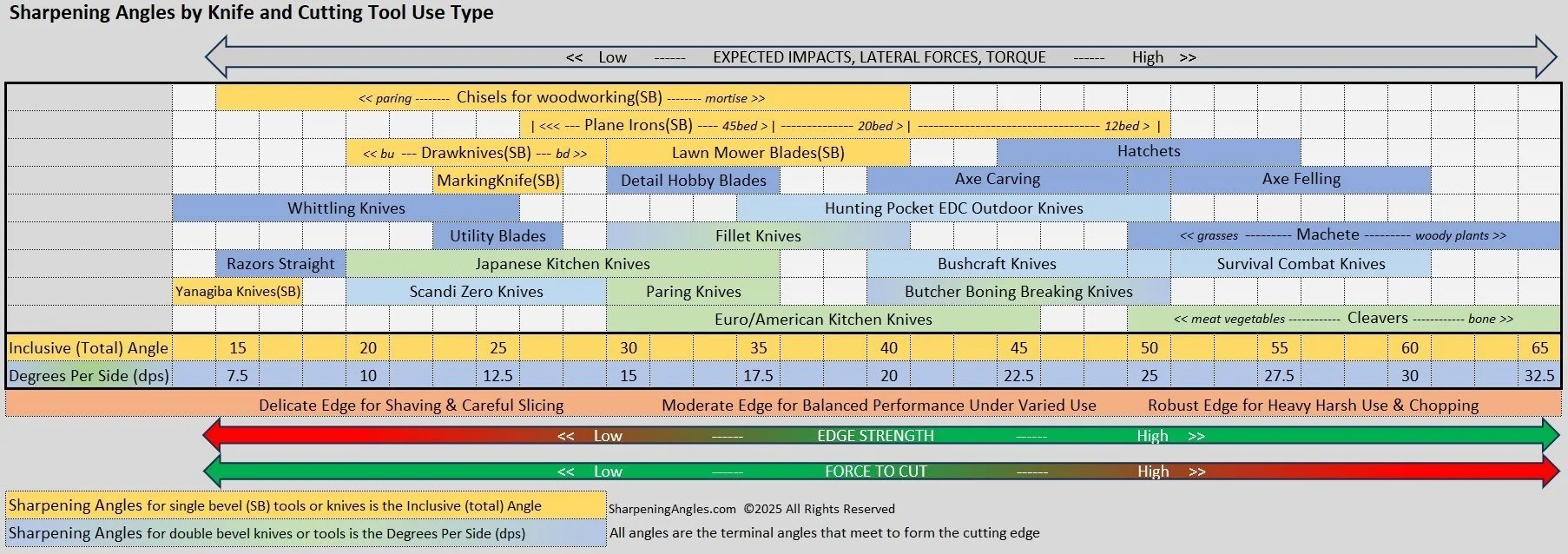
Sharpening Angles by Knife and Cutting Tool Use Type
Knives & Cutting Tools have varying recommended sharpening angles based on their intended use as seen in the bar chart above. The recommendations are driven by the expected forces the cutting edge will experience from impacts, lateral forces and torque during typical use.
As the expected forces increase, the sharpening angles must also increase to ensure that the cutting edge does not fail during normal intended use. When a blade is sharpened at an angle that is too low (to acute) to support the forces that it experiences, the cutting edge will fail quickly through excessive rolling, denting and chipping on a microscopic level leading to a dull blade.
Sharpening angle is directly related to edge strength - when the sharpening angle increases the cutting edge strength improves. Sharpening angle is inversely related to the force to cut or perceived sharpness - when the sharpening angle increases the force to cut or perceived sharpness gets worse.
This is the Sharpness / Edge Strength Tradeoff - Lower sharpening angles result in better force to cut / perceived sharpness but worse edge strength - Higher sharpening angles result in worse force to cut / perceived sharpness but better edge strength to resist edge rolling, denting and chipping from impacts, lateral forces and torque.
To optimize the performance of any blade the user must understand this tradeoff, reflect on their past experience with the blade and select the lowest (most acute) sharpening angle which still provides an acceptable degree of edge strength to resist edge rolling, denting and chipping. For better cutting performance there is often the temptation to reduce the sharpening angle below what is optimal resulting in excessive micro chipping, rolling and denting. This temptation often arises because of poor sharpening technique since even a survival knife properly and completely sharpened to a very strong 30dps/60 degrees inclusive will shave fine hair.
Our Sharpening Angle Decision Tree will assist with further understanding and selecting the optimal sharpening angle.
How does Sharpening Angle impact Edge Strength?
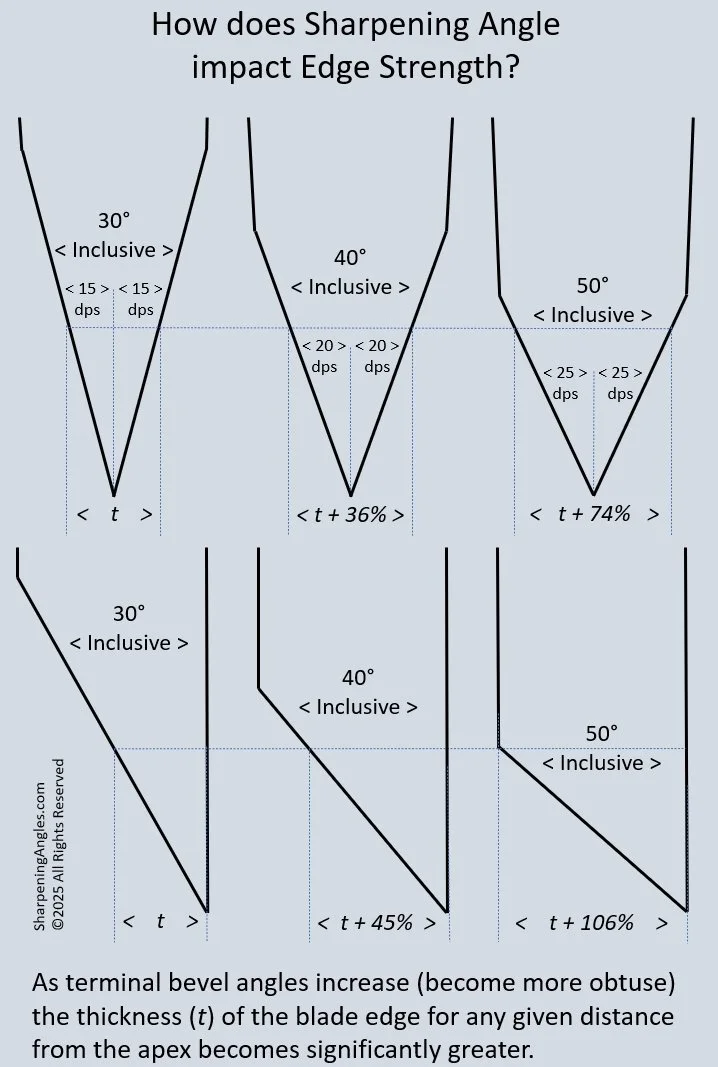
Let’s further explore how Sharpening Angle impacts Edge Strength. Edge Strength or Edge Stability is the ability of the microscopic cutting edge to withstand micro chipping, rolling and deforming (denting) all of which contribute to dulling.
As seen in the image above, as the terminal bevel angle increases, the thickness (t) and therefore strength of the cutting edge for any given distance from the apex becomes significantly greater. Consider if these profiles were large and made of plastic rather than steel. Imagine how much easier it would be to push over, dent or damage the 30 degree inclusive edge as compared to the 50 degree inclusive edge. The same is true for the cutting edge of your steel blade on a microscopic level.
Here are the numbers:
For a double bevel knife or cutting tool, 40 degrees inclusive is 36% thicker and stronger than 30 degrees inclusive and 50 degrees inclusive is 74% thicker and stronger than 30 degrees inclusive.
For a single bevel knife or cutting tool, 40 degrees inclusive is 45% thicker and stronger than 30 degrees inclusive and 50 degrees inclusive is 106% thicker and stronger than 30 degrees inclusive.