
Knife Blade Types, Bevel Types & How Dulling Occurs
To optimize the performance of knives and cutting tools one needs to first understand blade types, the benefits of the different bevel types, and what happens to the blade on a microscopic level with use.
What is the difference between a Single-Bevel blade and a Double-Bevel blade?
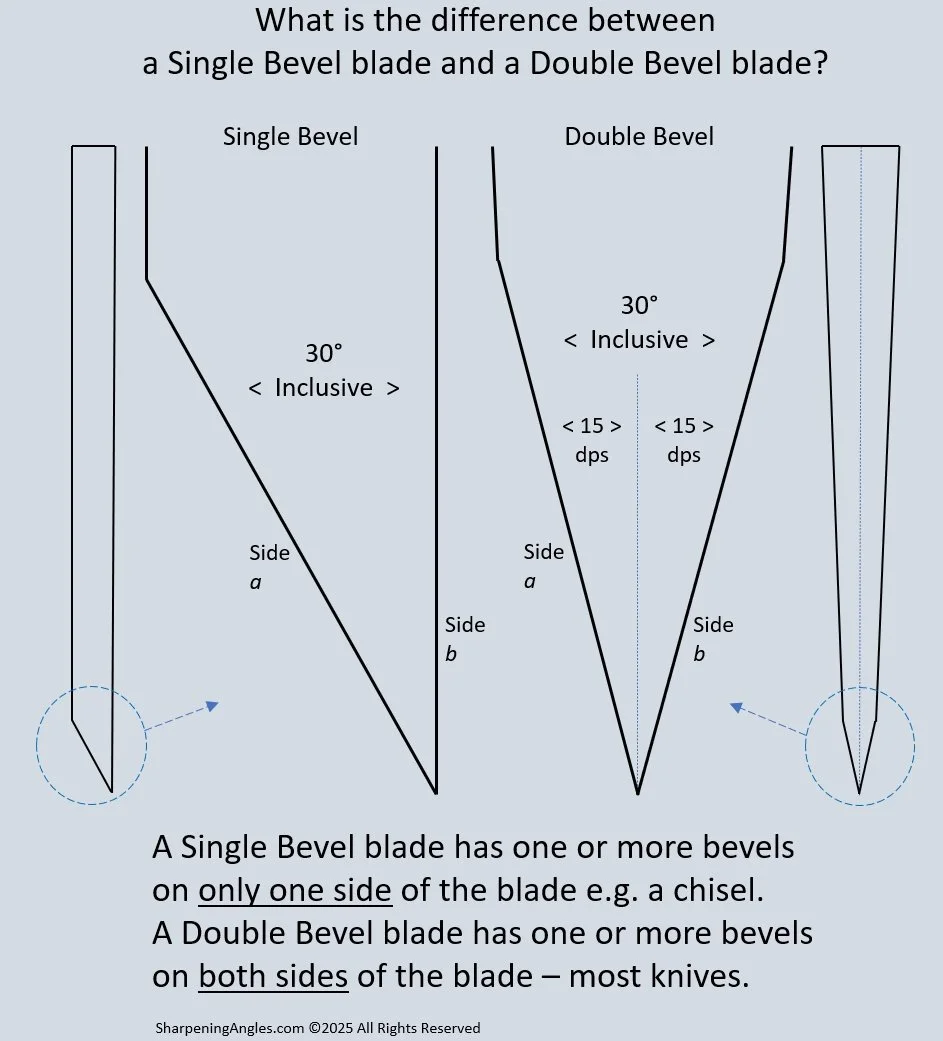
A single-bevel blade has one or more bevels on only one side of the blade. The other side of the blade is flat or at a zero degree angle all the way to the cutting edge. A wood chisel is an example of a single-bevel blade.
A double-bevel blade has one or more bevels on both sides of the blade. The bevels on one side of the blade usually but not always mirror or match the bevels on the opposite side of the blade. Most knives have double-bevel blades.
What are the various bevels that form the cutting edge on a double-bevel knife or cutting tool?
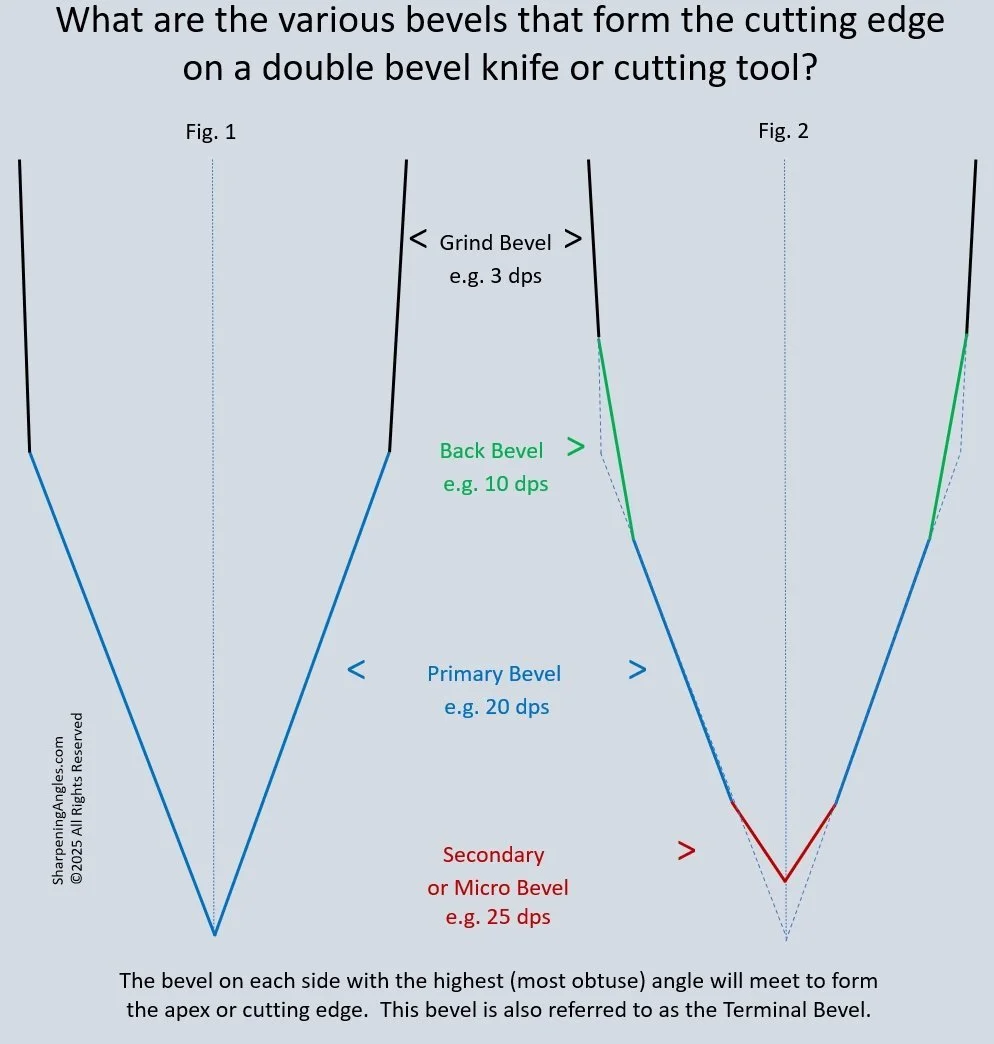
A Bevel is a surface of a blade that is at a converging angle to the opposite side of the blade. The Bevels cause the blade to taper down or thin from the spine to form the cutting edge. The Bevels with the highest angle (most obtuse) on each side of the blade meet to form the Apex or cutting edge of the blade.
The Grind Bevel of a knife or tool has the lowest angle on the blade. It starts the initial taper or thinning of the blade to form the cutting edge. The Grind Bevel is set by the knife manufacturer and is not generally ground or sharpened by the user of the blade except is the rare instance of a user completely reprofiling the blade. Grind Bevels range from about 2 dps (degrees per side) to about 8 dps. Chef and fillet knives generally have the lowest dps Grind Bevels. Thick spined hunting, bushcraft and survival knives generally have the highest dps Grind Bevels.
The Primary Bevel is the generally the widest bevel on the blade that is maintained by the user. The Primary Bevel is at a greater angle than the Grind Bevel. In the absence of a Secondary Bevel or Micro Bevel the Primary Bevel would Apex to form the cutting edge of the blade as seen in figure 1 in the above image.
A Secondary Bevel is an optional bevel which is thinner than the Primary Bevel and at a greater (more obtuse) angle than the Primary Bevel as seen in figure 2. A Secondary Bevel, when present, will form the Apex of the cutting edge since it is at a greater angle than the Grind Bevel and the Primary Bevel. A Secondary Bevel is usually about 5 dps greater than the Primary Bevel. The slight increase in angle of a Secondary Bevel can stabilize the edge and improve Edge Strength.
A Micro Bevel is an extremely thin optional Secondary Bevel which is usually about 5 dps greater than the Primary Bevel. By most opinions it would be barely visible and no larger that 0.004” or 0.1mm. It is generally created with only a few alternating passes on a 1000+ grit stone or ceramic rod. A Micro Bevel can stabilize the edge and improve Edge Strength and Edge Retention with minimal increase in the force to cut. A Micro Bevel is also a convenient final step to remove the burr which forms while sharpening.
A Back Bevel is an optional bevel added to a blade above, or closer to the spine than, the Primary Bevel as seen in figure 2. A Back Bevel must be at a lower angle (usually 5-10 dps lower) than the Primary Bevel. The purpose of a Back Bevel is to reduce the Thickness Behind the Edge (TBE) / Behind The Edge (BTE) thickness. A Back Bevel will often improve the cutting performance of a blade without weakening the cutting edge or Apex. A Back Bevel is often needed to restore cutting performance when a Primary Bevel becomes too wide and the TBE becomes too great as a result of many sharpenings.
A Back Bevel in the context of Single Bevel woodworking tools, like a plane iron, would be an optional very thin bevel added to backside of the blade which is otherwise at a zero degree angle. Technically adding a Back Bevel to Single Bevel woodworking tool would make it a Double Bevel blade.
The Terminal Bevel is the bevel with the highest angle. The Terminal Bevel on each side of the blade meet to form the Apex of the cutting edge. A Secondary Bevel or Micro Bevel is the Terminal Bevel when present. Otherwise the Primary Bevel is the Terminal Bevel.
A Compound Bevel is made up of two or more user maintained Bevels on the same side of the blade. This could be a Primary Bevel and a Secondary Bevel. A Primary Bevel and a Back Bevel. Or a Primary Bevel with both a Secondary Bevel and a Back Bevel.
Behind The Edge thickness (BTE) or Thickness Behind the Edge (TBE) is the thickness of the blade at the top or thickest part, of the Primary Bevel. Reducing the BTE/TBE of a blade with a Back Bevel will improve the Force to Cut or perceived sharpness.
Edge Geometry is the physical characteristics of a blades cross section. This would include the blades overall thickness and height, the Thickness Behind the Edge and the angles and widths of all Bevels which cause the blade to taper down from the spine to form the cutting edge. Edge Geometry impacts the cutting performance of a blade.
How do Knife & Cutting Tool Blades become Dull?
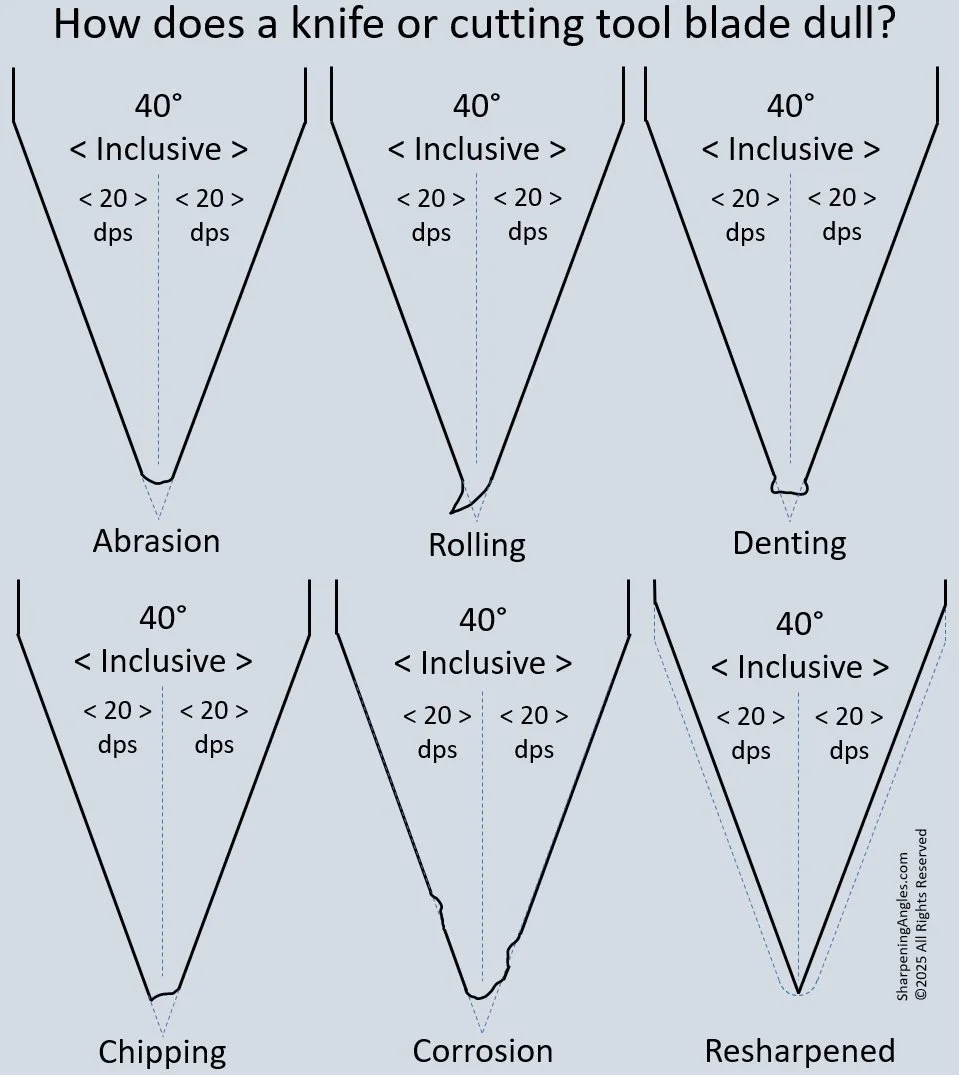
Knife and cutting tool blades become dull in 5 different ways. With regular use the dulling generally occurs through all 5 ways simultaneously on a microscopic level. The exception to this would be misuse or harsh use of the blade which may make one or more dulling factors so severe that is it visible to the naked eye. With appropriate sharpening angles and careful use of the blade some of dulling factors can be minimized and others can not. Let’s further explore the ways that dulling occurs.
Abrasion - All materials that you are cutting and all materials that your blade comes in contact with are abrasive to some degree. Some materials are only slightly abrasive while others are highly abrasive. As a result when you use your knife or cutting tool microscopic bits of the cutting edge are being scratched or worn away. This occurs at all sharpening angles and is unavoidable. It results in an increase in the radius or diameter of the cutting edge.
Rolling - When using a knife or cutting tool all forces acting on the cutting edge are not directly parallel to the centerline of the blade or equal on both sides of the blade. Instead some of the forces are lateral or pushing on the blade from the side and these side forces are often unbalanced. When the lateral forces are unbalanced and exceed the the strength of the cutting edge, microscopic deforming or bending of the cutting edge occurs. A blade with a higher HRC hardness will better resist edge rolling than one with a lower HRC hardness. However, a blade with higher HRC hardness will be more prone to micro-chipping if the strength of the cutting edge is exceeded. Butchers tend to use knives with lower HRC hardness to minimize micro-chipping and compensate for edge micro-rolling with frequent quick honing on a steel honing rod to realign the cutting edge with the centerline of the blade.
Denting/Deforming - When a knife or cutting tool encounters a relatively hard material at an angle that is fairly parallel to the centerline of the blade and the force exceeds the strength of the edge, the cutting edge may dent or flatten rather than roll. This relatively hard material could be bone, a cutting board, a counter top, etc. Like rolling, a blade with a higher HRC hardness will better resist edge denting than one with a lower HRC hardness. However, a blade with higher HRC hardness will be more prone to micro-chipping if the force exceeds the strength of the cutting edge.
Chipping - Knives and cutting tools with higher HRC hardness resist edge rolling and denting better than those with lower HRC hardness. However, knives and cutting tools with higher HRC hardness are more prone to micro-chipping. When blades with a higher HRC hardness experience forces that exceed the strength of the cutting edge a micro-chip is more likely to form. Unlike a rolled edge, a microchip can not be realigned through honing/steeling. The sharpness of that minute section of the blade can only be restored through resharpening.
Corrosion - All knife and cutting tool blades will corrode to some degree. Carbon steel blades are highly susceptible to corrosion. Stainless steel blade are much less susceptible to corrosion. Corrosion occurs when the elements in the steel react with the environment (e.g. oxygen in the air, chlorides in sea water, etc). Moisture accelerates the the corrosion process. For this reason a highly sharpened blade will slightly dull when stored especially when stored in a damp environment. Corrosion can be minimized by keeping stored blades dry and coated in a light coat of oil.
Resharpened - The final image above details how resharpening restores the cutting edge of a blade. The terminal bevel on each side of the blade is ground away reducing the thickness of the apex. When the thickness/diameter of the apex reaches about 0.25 micron (1/4000 of a millimeter) the blade will start to shave fine hair.