
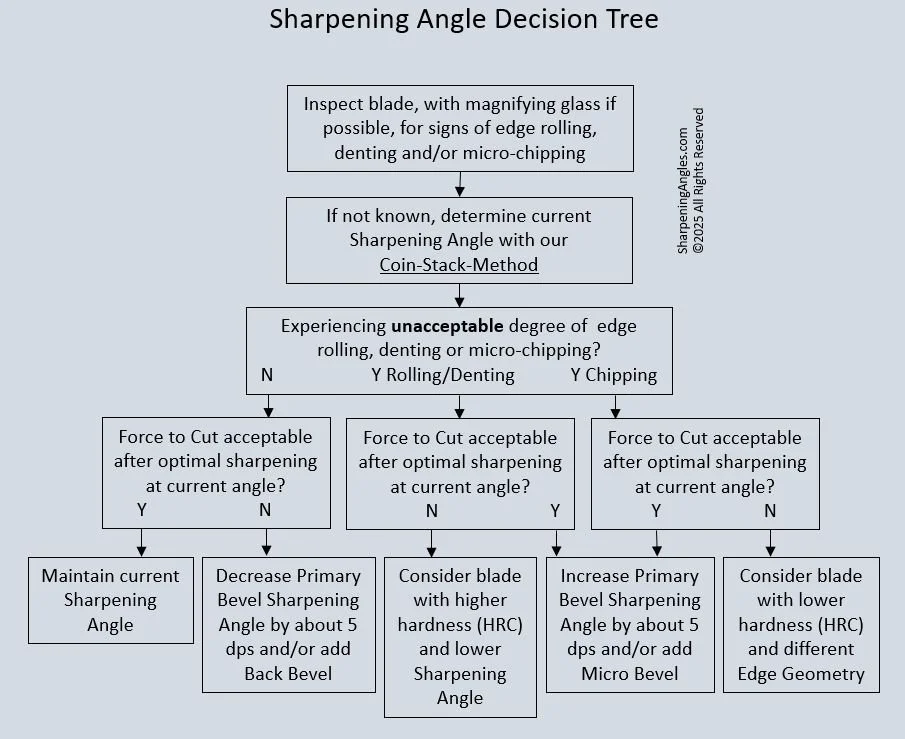
Sharpening Angle Decision Tree
The most important factor when deciding what angle to sharpen a blade at is NOT the manufacturer’s target sharpening angle. Instead it’s the user’s past experience with the blade and the condition of the blade after a typical use period. Did the blade cut the usual materials with a low enough force to cut / was it sharp enough? Did the blade stay sharp for a reasonable period of time? Does the blade sustain an unacceptable degree of micro chipping? Does the blade sustain an unacceptable degree of edge rolling and/or denting deforming? Does the blade require significant resharpening after a typical use period? Questions like these build out the user’s past experience with the blade and drive the optimal sharpening angle.
We have summarized the sharpening angle decision process in our Sharpening Angle Decision Tree.
It begins with a careful inspection of the blade under good lighting after a typical use period. An inexpensive magnifying glass or jewelers loupe is very useful for blade inspection. They can be found on-line for just a few dollars. You will be assessing the condition of the cutting edge looking for signs of edge rolling, denting and micro-chipping.
If not already known, use our Coin-Stack-Method to determine the current angle of the Terminal Bevel.
Reflecting on the inspection, if there was NOT an unacceptable degree of cutting edge rolling denting and/or micro-chipping and the force-to-cut was acceptable after proper sharpening at the current angle then proceed to resharpen at the current angle.
If there was NOT and unacceptable degree of edge rolling denting and/or micro-chipping and the force-to-cut was NOT acceptable after proper sharpening at the current angle then reduce the angle of the Primary Bevel by about 5dps and/or add a Back Bevel.
If there was an unacceptable degree of primarily edge rolling and denting and the force-to-cut was NOT acceptable after proper sharpening at the current angle then consider a blade with a higher hardness (HRC) and a lower sharpening angle.
If there was an unacceptable degree of primarily edge rolling and denting and the force-to-cut was was acceptable after proper sharpening at the current angle then increase the angle of the Primary Bevel by about 5 dps and/or add a Micro Bevel.
If there was an unacceptable degree of primarily edge micro-chipping and the force-to-cut was acceptable after proper sharpening at the current angle then increase the angle of the Primary Bevel by about 5 dps and/or add a Micro Bevel.
If there was an unacceptable degree of primarily edge micro-chipping and the force-to-cut was NOT acceptable after proper sharpening at the current angle then consider a blade with a lower hardness (HRC) and a different Edge Geometry such as an added Micro-Bevel and/or Back Bevel.
For the purposes of the Sharpening Angle Decision Tree we define proper or optimal sharpening as a sharpening operation which results in a blade which will pass common low-tech sharpness tests such as cleanly slicing a hanging sheet of paper, hanging on a finger nail held at 45° and shaving fine hair.